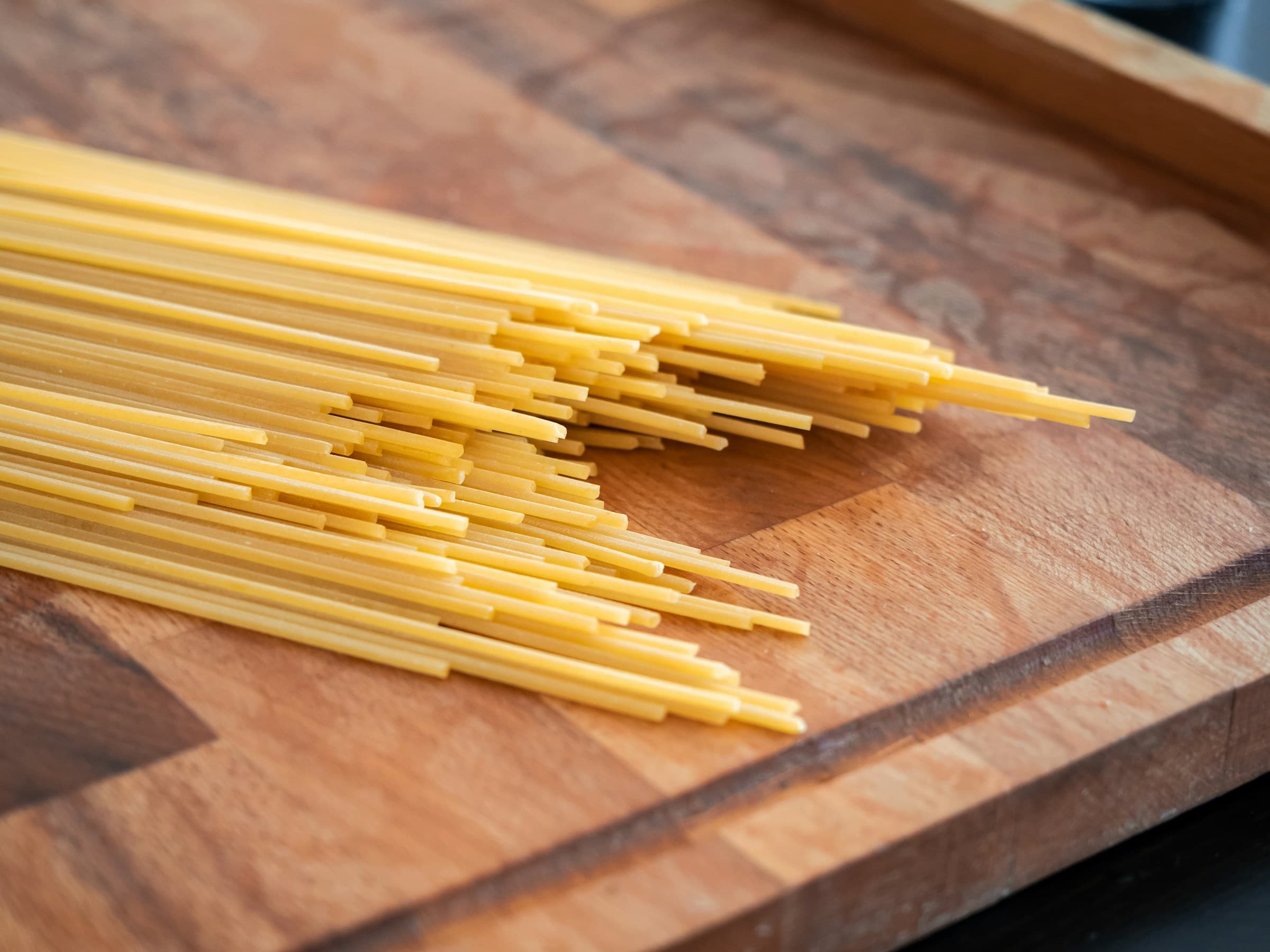
The long strand that set the standard.
- Italian
- Spaghetti
- Category
- Long
- Region
- Naples
- Pastas
- 7 catalogued
The story
Spaghetti's story begins in 12th-century Sicily, where Arab traders introduced dried pasta suited for long sea voyages. Naples became its adopted home, and by the 19th century, industrial bronze dies made spaghetti a national staple. Its name, a diminutive of spago ('string'), first appeared in print in 1836.
Shape & purpose
A round, solid cylindrical strand, typically 25cm long and about 2mm in diameter. The smooth round cross-section is deceptively simple — its length and flexibility let it twirl and hold sauce through surface tension rather than crevices.
Designed for oil-based, thin tomato, and seafood sauces that cling by coating rather than clinging to ridges. The strand's length rewards the twirl — each forkful should be its own contained bite.
Sauce pairings
- 01Aglio e olioGarlic, chili, olive oil — the test of any strand.
- 02Alle vongoleClams, white wine, parsley — a Neapolitan classic.
- 03PomodoroSimple tomato & basil lets the wheat speak.
- 04Cacio e pepeThough tonnarelli is traditional, spaghetti works.
Cooking technique
Salt the water until it tastes like the Mediterranean — roughly 10g per liter. Cook 1–2 minutes less than the package suggests and finish in the sauce with a ladle of pasta water. Never rinse, never oil. Reserve the starch.